Welcome to Ouranoupolis
Residents : 960
Distance from Thessaloniki : 120 km
Police Outpost : 0030 23770 22236
Port Authorities : 0030 23770 71248
Local Municipal Office 0030 23770 71216
Ouranoupolis Information
On the top of the Mount Athos peninsula and at a distance of 120km away from
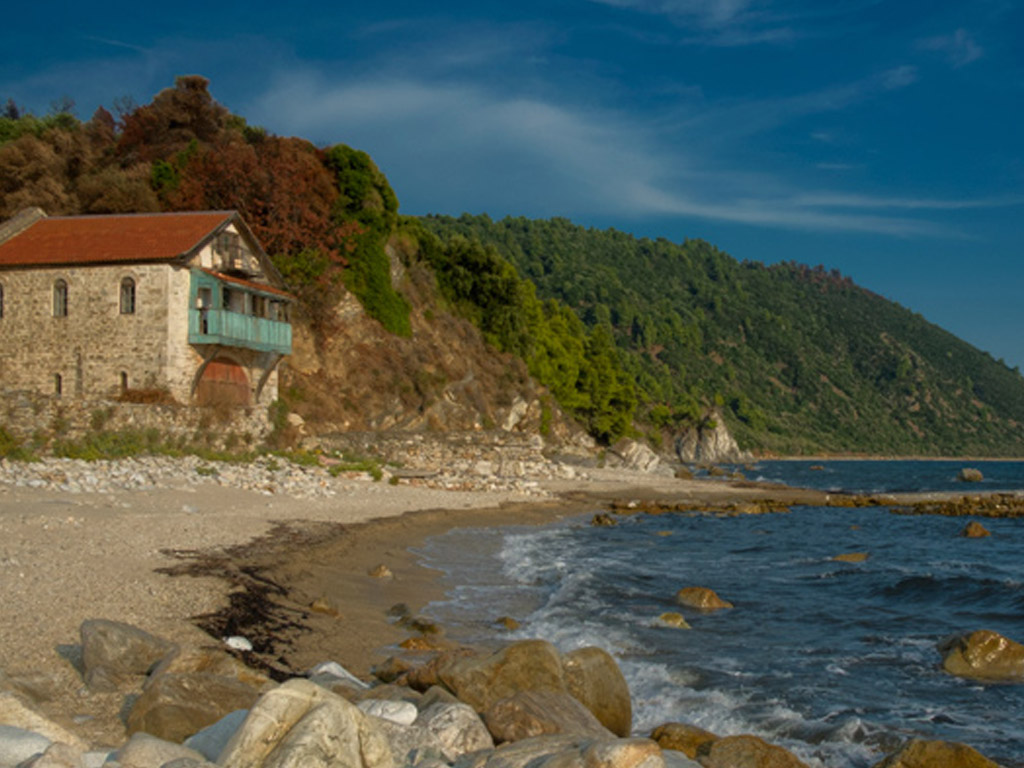
the airport of Thessalonica lies Ouranoupolis, the Gate of Mount Athos. Ouranoupolis
is a divine landscape, combining mountainous and sea beauties, promising unforgettable
holidays, especially for the travelers seeking the relaxation, away from the
stress of the town. The village seems to be a serene portrait which welcomes
the pilgrims and prepares them for their spiritual journey to Mount Athos. Besides
that Ouranoupolis means in Greek, the city of the heaven, the city who drives
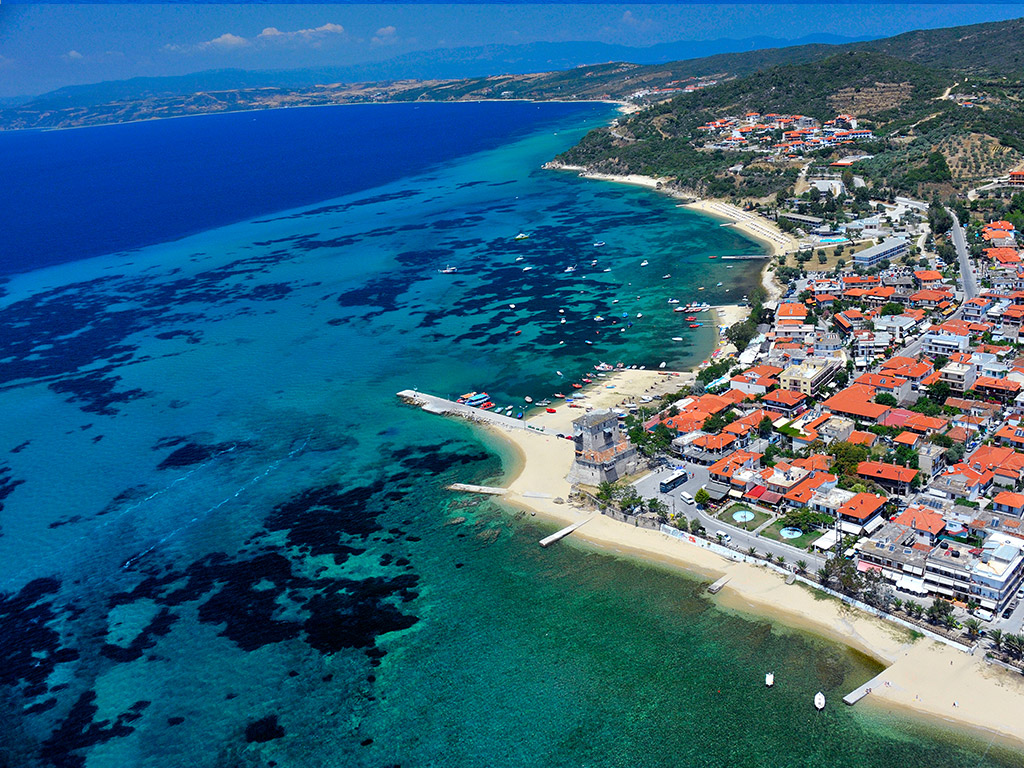
you up to heaven... Its visitors are welcomed by the Tower of Andronikos, the
“alert protector” of the city for centuries, built in 1344 by the monastery Vatopediou
as a protection from the pirates. In front of the tower lies the port, the gate
of Mount Athos, where either the ferry boats travel to the monasteries or cruise
around the peninsula at a distance of 500m from the beach. In Ouranoupolis the
visitors apart from the hospitality and the friendly spirit of the residents,
have the unique chance to savor fresh fish caught in the Mount Athos Golf in
traditional fish taverns, to relax in pleasant cafes or bars drinking cocktails
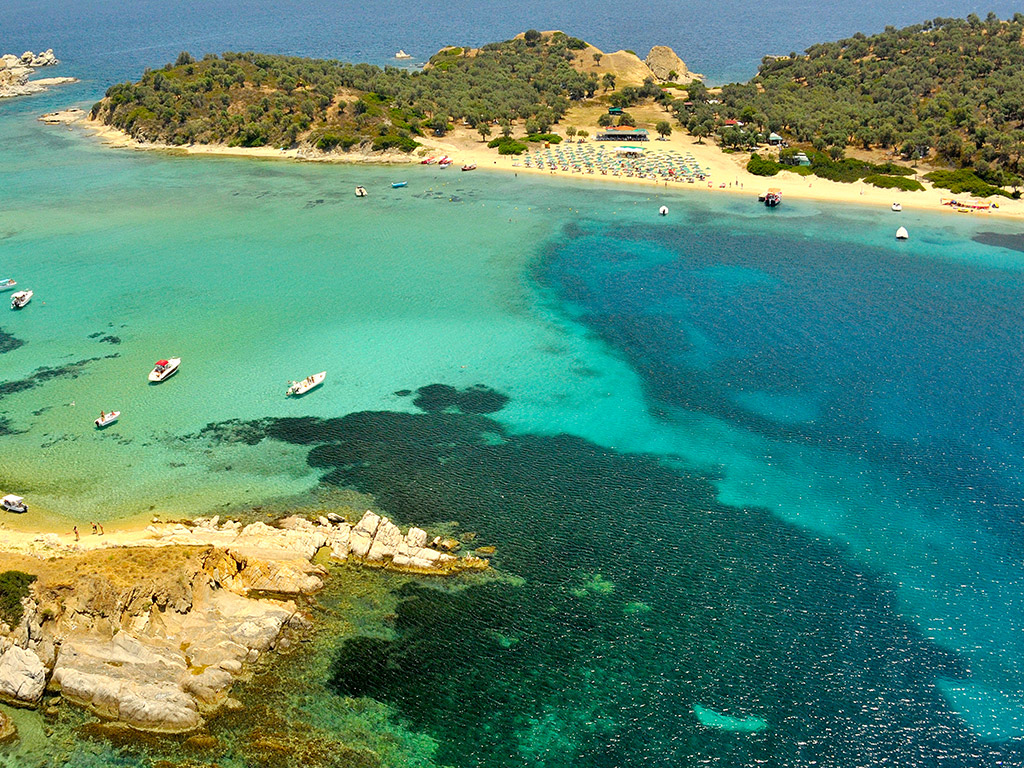
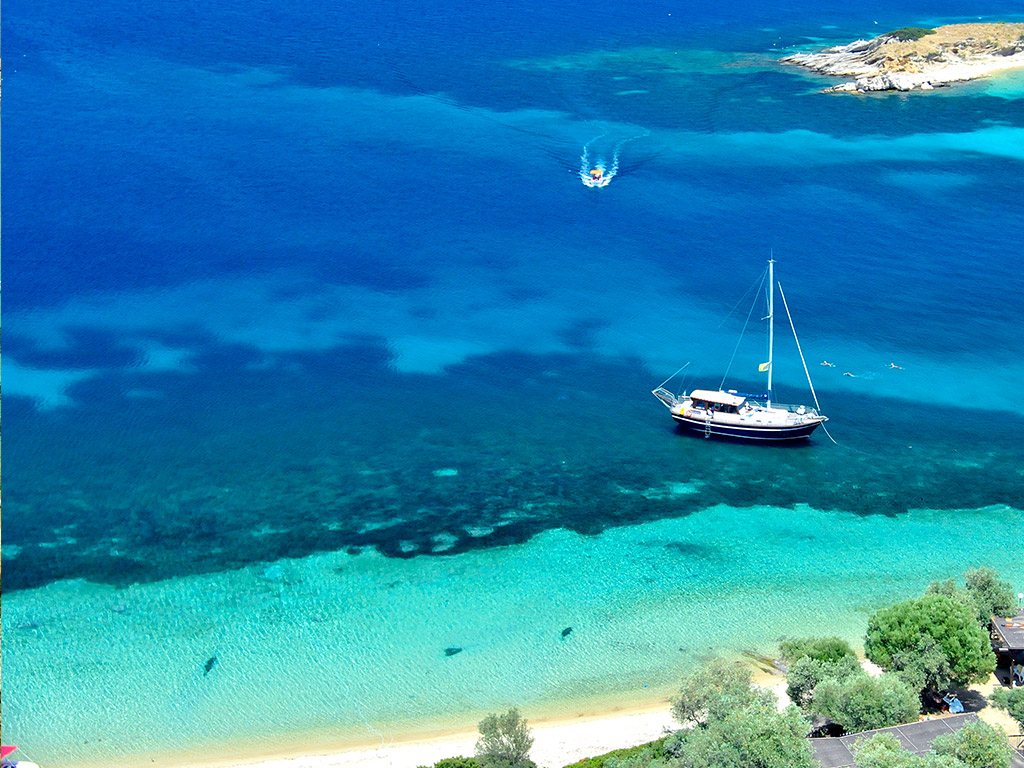
on the beach watching the sunset. During the day the activities give unique opportunities
for swimming or fishing at exotic beaches across Ouranoupolis, on the small isles,
which can be visited either by small fishing boats or small speedboats. There
are ferry boats which daily set off from the harbor for the Mount Athos cruise.
Diving, sea sports, cars and motorbikes for rent are being at the disposal of
the visitors. Ouranoupolis is surrounded by a wonderful forest which is being
offered for walks and exploration, viewing to the village and Mount Athos. Inevitably
Ouranoupolis is the last stop for all pilgrims who wish to visit Mount Athos
since they have to collect early in the morning the Diamonitirio, a written authorization
and the ticket for the ferry boat.
ANCIENT OURANOUPOLIS
In the region of Ouranoupolis, one kilometre east of the village, and during
the work of private property levelling, a Roman grave was revealed. It
was found in low elevation in a place called "kokkinohorafo",
near the street that leads to the abbey of Zigou near the border of Mount
Athos.
At a small distance, further north, there is a water bridge and a post byzantine
water gallery, as well as various other manufactures relative with the water
feeder of the region. In 1959 further uphill, in a graphic place called "Kokkinara",
on private property, Manolis Andronikos a very important archeologist discovered
relics and remains of an important hellenistic building and also of ancient objects,
such as earthen oil lamps, coins and lead items. The research was most probably
on a rather small scale so it was not promoted.
The first discovery although not impressive, adds a new topographic element to
the undiscovered region.
This grave is a constructed square-shaped grave orientated parallel to the seashore.
A thin layer of stone was on top of it. Similar layers of stone have been found
within the region proving the existance of an ancient organized cemetery.
The walls of the grave are built off-handedly with stones and conjunctive matter
of yellowish clay, while the natural soil constitutes its flooring. The dead,
in supine position, was placed directly in the natural red soil. The only belongings
of the dead were a coin placed on his thorax, and an earthen oil lamp next his
left leg. Chronologically this grave dates back to the third quarter of the 3rd
century A.C.
THE TOWER OF OURANOUPOLIS
The tower is known to have existed already in 1344, but appears to have
been older than
this. In May 1379, the "despot" (King) of Thessaloniki, loannis Palaeologos,
was hosted at the tower and during his stay there granted it exemption from taxes.
It must have suffered considerable damage from the earthquake of 1585 and, probably,
received extensive repairs. In August 1858 the tower is reported "empty
and uninhabited inside" (presumably after being burned down during the devastation
of Chalkidiki in the revolution of 1821), but this same year saw the beginning
of extensive repair and reconstruction works that gave it its present form.
Recently, the tower was consolidated and restored by the 10th Ephorate of Byzantine
Antiquities. During the course of this project, the main historical phases of
the building were identified as follows:
• The entire lower part of the stone structure, apart from the two upper storeys,
belongs to the Byzantine tower. It may be assigned on the basis of its typology
and construction to the few known examples of the 11th-12th century.
• The two upper storeys and another one (or at least a battlement level) now
lost, date from the Ottoman Domination era, probably after the earthquake of
1585.
• The entire wooden interior of the tower, together with its present roof, belong
to the 19th century repair mentioned above, which seems to have been completed
in 1862. Later, the external sloping buttress wall was added, probably after
the earthquake of 1905. Nowdays, after the recent restoration works, the interior
of the tower is preserved with the original constructions of the 19th century.
Against the eastern side of the tower rests the annex building of barbakas (barbican),
the fortified enclosure, which seems to have been a side building of the early
Ottoman domination era, with later repairs. Today's residence and the storerooms
inside barbakas were built in the middle of the 19th century.
To the north-west of the tower stands the building of arsanas (boat-house), built
in 1865, along with the now lost jetty. It consists of a half-underground space
for the keeping of the boat, the storage mezzanine and the residence of the upper
level with its loggia.
The metochion estate owned many other buildings (storehouses, barns, an oil press,
tenant lodgings ("kolligospita"), wells, etc), only two of which are
preserved, about fifty meters to the south-west of the tower. The installations
of the metochion were used for many years as lodgings for the new inhabitants,
who built Ouranoupolis in 1923.
Nowdays, the tower estate belongs to the Greek Ministry of Culture.
Information: +30 23770 71389
http://www.ierissos.gr/
BUS SERVICE FROM THESSALONIKI TO TO OURANOUPOLIS
The bus station of Halkidiki is situated in the high way from Thessalonica
to Nea Moudania, 10 minutes by TAXI from the airport. TEL: (0030 2310 316555).The
one way ticket to Ouranoupolis costs €10.70 and the return ticket costs
€18.50(valid for one month).
BUS
TIMETABLE (SUMMER)
FROM 16th JUNE TO 9th SEPT |
| THESSALONICA – OURANOUPOLIS |
OURANOUPOLIS – THESSALONICA |
05:30*
06:15
08:30
10:45
12:45
14:30
16:30
18:30 |
05:30*
08:00
09:30
12:00
14:15**
16:00
18:15 |
* except Sundays
and holidays.
** connected to Mount Athos ferryboat. |
BUS TIMETABLE (WINTER)
FROM 10th SEPT. TO 15th JUNE |
| THESSALONICA – OURANOUPOLIS |
OURANOUPOLIS – THESSALONICA |
05:30*
06:15
08:30
10:45
12:45
14:30
17:45 |
05:30*
08:00
09:30
13:00
14:15**
17:30 |
* except Sundays and holidays.
** connected to Mount Athos ferryboat. |
TRANSFER FROM MACEDONIA AIRPORT (THESSALONICA)
TO OURANOUPOLIS WITH TAXI OR MINI BUS: 0030 23770 71085